Maximize GPU performance and tokens/watt efficiency

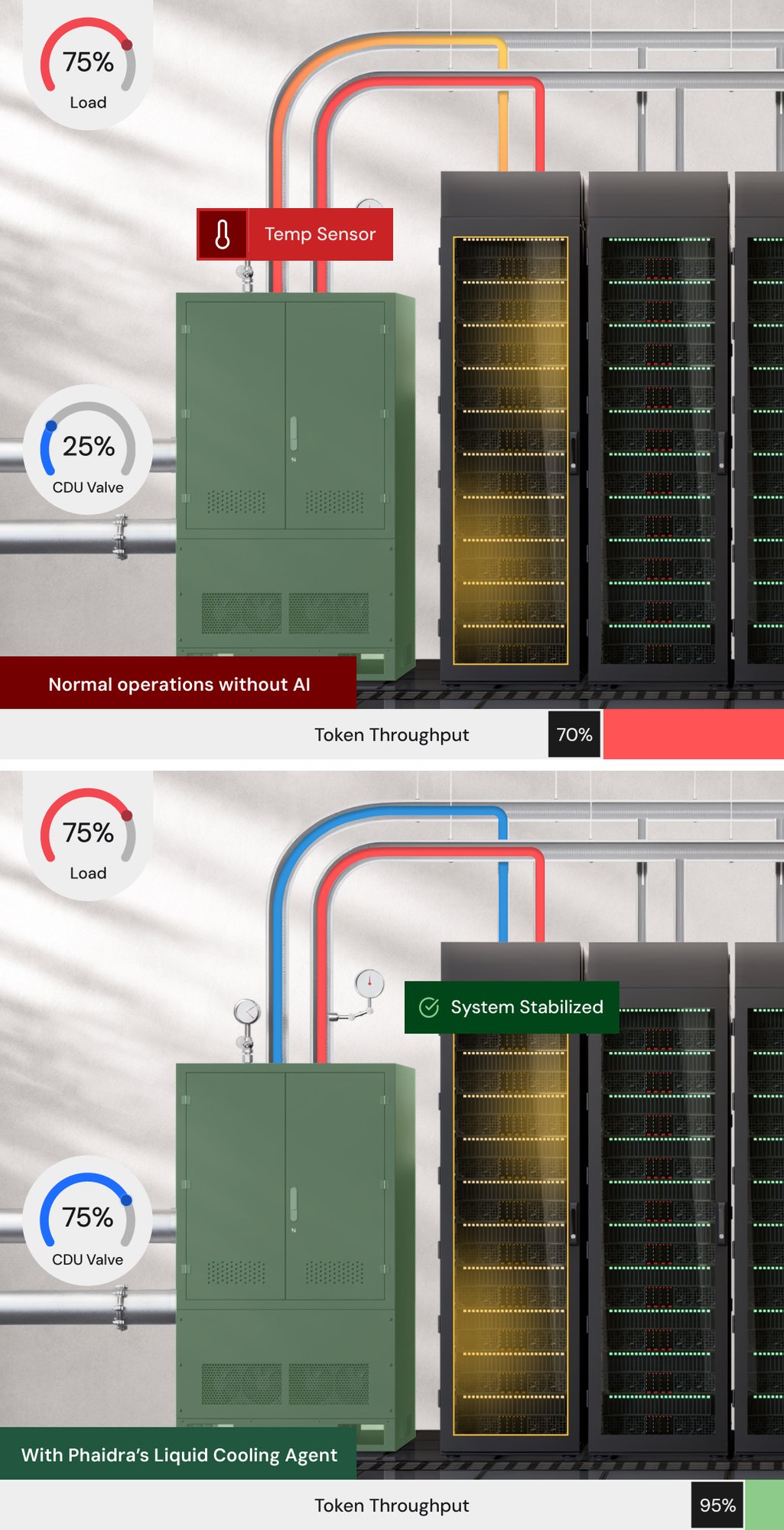
Phaidra’s Liquid Cooling Agent proactively stabilizes CDU performance during rapid AI workload spikes to reduce GPU throttling, improve cooling efficiency and unlock more revenue generating compute capacity.
✅ Mobile_x3_1029x2007
LCA

Traditional cooling systems react too slowly for synchronized AI workloads

AI workloads create rapid, synchronized power ramps that traditional temperature based control loops can’t respond fast enough. Operators compensate through aggressive sub-cooling, sacrificing efficiency and compute density.

Shift from reactive to proactive control

Phaidra uses real time rack power as a leading indicator to detect workload spikes before temperatures rise. The Agent proactively adjusts CDU setpoints in seconds to maintain thermal stability under volatile AI workloads.

Built for better performance

icon-16

Proactive thermal response

Reduce control latency from minutes to seconds during rapid GPU load ramps.
icon-17

Improved cooling efficiency

Safely raise water temperatures to improve PUE without risking GPU performance.
icon-18

Self-learning Agent

Continuously adapt CDU behavior to changing workloads, hardware drift, and site conditions.
icon-19

Reduced operational burden

Eliminate constant manual tuning with autonomous optimization across liquid cooled environments.

Validated under real AI workloads

Production testing with NVIDIA, CoreWeave, and Applied Digital.

75-80% reduction in thermal overshoot

Reduced 5-6°C spikes to ~1°C

Stable operation during rapid load ramps

AI agents for liquid cooled
AI factories

Read the white paper authored by Phaidra, NVIDIA, CoreWeave and Applied Digital to learn how to prevent GPU throttling and safely increase facility temperatures to drive more revenue-generating compute.